Showing posts with label Monster Lair. Show all posts

Sunday, December 04, 2016

Get your piping hot #HudsonMonth game recommendations here!

In case you weren't already aware, December is "Hudson Month," according to my friend Anne Lee (of the Chic Pixel blog).

What does that mean? Basically, it means you're supposed to play one or more games made by the now-defunct developer and publisher Hudson Soft sometime this month and then blog or tweet about the experience (using #HudsonMonth in the latter scenario)--if you're willing and able, of course.

If Hudson Soft doesn't ring a bell, maybe the names of some of the company's most famous releases will: Adventure Island, Bomberman and Bonk's Adventure.

Although there's nothing wrong with playing through one of those titles or their sequels for this game-along, there are many other--and oftentimes better--options available to you, such as the following:


DoReMi Fantasy: Milon no DokiDoki Daibouken (Super Famicom)--There weren't many side-scolling platformers made for the Super Famicom or SNES that can compete with Nintendo's own Super Mario World or Yoshi's Island. DoReMi Fantasy is one of the few. Greatly helping matters is this cart's gameplay, which is reminiscent of Mizubaku Daibouken's. Physical copies (loose or complete) tend to be absurdly pricey these days, but that's not a problem if you've got a Wii or Wii U, as DoReMi Fantasy can be bought from both of their online shops for just a few bucks.


Hatena Satena (GameBoy Advance)--If you like Picross or even that old standby, Minesweeper, you'll love this 2001 Japan-only GameBoy Advance title. That's because Hatena Satena combines elements of both of those popular puzzlers, and the resulting effort more than stands on its own. Even better, Hatena Satena has a funky aesthetic that puts that of its predecessors to shame. Relevant aside: Compile's Guru Logi Champ will provide you with even more Picross-y thrills should Hatena Satena not fully satisfy your craving.


Kororinpa (Wii)--This is one of those early Wii games that made full use of the system's motion-sensing controller. In fact, Kororinpa is played by twisting and turning the Wii Remote to do the same to the title's labyrinthine levels--with the goal being to roll a ball (or something resembling a ball, at least) from each stage's entrance to its exit. That's harder than it sounds, of course. Thankfully, the game's colorful backdrops and chipper background tunes help take the edge off some of its tension. Bonus: cheap copies of both the first Kororinpa and its sequel can be bought via eBay these days.


Monster Lair (TurboGrafx-16)--If you're a PC Engine aficionado, you likely know this game by its original name, Wonder Boy III: Monster Lair. Whatever you call it, though, it's a great little game that's one part platformer and one part shoot 'em up. There's more to Monster Lair than its intriguing gameplay, though. The game's also a real looker thanks to its liberal use of color and its big, bold sprites. Its soundtrack is pure bliss, too. Relevant aside: I saved up and bought a pricey TurboGrafx-CD add-on as a teen solely because of this game.


Nuts & Milk (Famicom)--This single-screen platformer (don't be fooled, it's nothing like Bubble Bubble) was the first third-party game to be released for the Famicom. Despite that, and despite the fact that Nuts & Milk is just as fun as many classics from the same era, maker Namco never brought it to North America. Thankfully, it's easy enough to play in 2016 and beyond no matter where in the world you live. Actual carts are both abundant and cheap (on eBay and the like), or of course you can go the old "boot up the ROM" route. (If you own a Japanese 3DS, Wii or Wii U, you can buy Nuts & Milk from that region's Virtual Console. Unfortunately, the same can't be said if you own a recent Nintendo system that originates from North America or Europe.)


Princess Tomato in the Salad Kingdom (NES)--All you really need to know about this 1991 release: it's an old-school point-and-click adventure starring anthropomorphic pieces of produce. That alone should make you sit down and play it, in my opinion. If that's not enough, consider its grin-inducing visuals and its jaunty soundtrack. Also, Princess Tomato in the Salad Kingdom can be picked up quickly and cheaply via the Wii eShop if you have that Nintendo console or the Wii U. Why the higher-ups at Konami (which now owns Hudson's intellectual properties) have yet to slip the game onto any region's 3DS eShop is beyond me.


Saturn Bomberman (Saturn)--If you play just one of the games discussed here, let it be this one. In my humble opinion, this is the best, most enjoyable Bomberman game to ever see the light of day. Plus, its graphics are so adroitly drawn and animated they'll make you tear up. As for Saturn Bomberman's music, I can't say it'll make you cry, but it'll definitely help set the mood for a properly thorough play session. If you're without a Sega Saturn and a copy of this game, by the way, you can buy the next best thing, Bomberman '94 for the PC Engine, from the Wii eShop or the PlayStation Store.


Star Parodier (PC Engine)--I fell in love with this overhead, vertical-scrolling shoot 'em up the second I found out one of its selectable ships was a PC Engine system that takes down oncoming enemies with HuCards and CDs and deflects their projectiles using controllers that double as as shields. (You can choose to pilot Bomberman, too, curiously enough.) Sadly, that's about the wackiest thing you can say about Star Parodier. The rest of its content is quite a bit less intriguing than similar games like Parodius and Pop'n TwinBee. Still, this Super CD-ROM2 title is well worth checking out if you're a fan of the shmup genre in particular or cute games in general.

Are you a fan of a Hudson Soft-made or -published game not discussed here? Let me--and others--know about it in the comments section below.

Friday, August 29, 2014

Five TurboGrafx-16 memories in honor of the system's 25th anniversary

I may not have the best memory in the world, but I'll probably never forget how I felt in the months, weeks and days leading up to the North American release of NEC's TurboGrafx-16, a games console that straddled the line between the 8-bit (think the Nintendo Entertainment System) and 16-bit (Sega's Genesis and the SNES) generations.

Specifically, I don't think I've ever been more excited about a system's launch than I was around Aug. 29, 1989, which is when the TurboGrafx-16 first hit store shelves on this side of the pond.

A lot of that "Turbo fervor" had been fanned, of course, by the magazine articles I'd read--over and over and over again--about this console's two-year-old Japanese counterpart, the PC Engine, and its extensive catalog of odd- and brilliant-looking games, including the handful that are mentioned below.

Sadly, and stupidly, after enjoying it for a good number of years, I sold my TurboGrafx-16 collection--which at one point included the base system, the pricey CD attachment, a TurboDuo and 30 or so games--via an ad in our city's main daily newspaper around the time of the Sega Saturn's Japanese release. (In fact, I used the money I made from this sale to buy an import Saturn--which I later sold to pay for a Dreamcast.)

Rather than dwell on that rather negative memory, though, I'd prefer to focus on a few positive ones, such as the following, on this, the 25th anniversary of the release of NEC's quirky and woefully under-appreciated (in this region, at least) console:


1. I'm one of about three people who enjoyed The Addams Family game--Don't get me wrong, even as a teen I knew this US-made (back when such a thing was considered the opposite of a good thing) action title was a turd, but I liked it all the same. I have a feeling some of that was due to my interest in the 1991 film this release was based on, but I also think it had something to do with this ICOM-developed game allowing users to explore the iconic Addams mansion and its grounds. That isn't going to be enough to make most folks fall in love with this often-iffy tie-in, of course, but it was more than enough for me at the time.


2. I bought my very first Japanese game (Detana!! TwinBee), along with my first converter cart, for this aesthetically challenged system--I can't remember the name of the retailer, sadly, but I know I had to place the order over the phone, and I had to borrow my parents' credit card to pay for it. Also, my mom had to help me modify the converter cart, as at first it didn't fit into the HuCard slot of my TurboGrafx-16 system. As for my memories of the game itself? Actually, it kind of bored me. Detana!! TwinBee isn't a bad shoot 'em up, of course, and it's grown on me in the ensuing years, but it's also nowhere near as thrilling as similar games like Parodius Da! or Coryoon.


3. I've always regretted not playing It Came From the Desert, J.B. Harold Murder Club and Magical Dinosaur Tour--Actually, I finally added the Japanese version of Murder Club to my collection late last year, but of course I've yet to play it. Still, at least it's a possibility at the moment. Anyway, you're probably wondering why I wish I'd played two TG-CD titles that have been heavily derided over the years? I'm not sure, to be honest. I think it's likely to be related to nostalgia, as all three of these games were released at a time when games featuring digitized video and the like were viewed as the future of the medium. It's clear now that view was a false one (to put it mildly), of course, but at the time some of these games were surprisingly appealing. Or at least they were to me.


4. The main reason I picked up the TurboGrafx-CD peripheral was for Monster Lair--Admittedly, by the time I finally wandered, awestruck and slack-jawed, into the local Toys "R" Us (man, those were the days) to pick up this mammoth add-on, Ys Book I & II had entered my consciousness as well, but that doesn't change the fact that Monster Lair is the game that pushed me to hand over $400 for it. Was it worth the price of admission? Well, no, not when you put it that way, but I never regretted either purchase, I'll tell you that much. Also, I still have a special place in my heart for this odd shmup-platformer hybrid and play it fairly regularly, so I'd say the original purchase more than served its purpose.


5. I didn't much care for Parasol Stars the first time I owned it--I'm guessing this may be the most shocking of all the TurboGrafx-16 memories I share in this post. After all, Parasol Stars now is one of my all-time favorite games (despite the fact that I think it pales in comparison to its predecessors, Rainbow Islands and Bubble Bobble). If memory serves, my parents bought this for me as a birthday or Christmas gift--without me asking for it, I should add. (Maybe they knew me better than I knew myself at that point?) I remember gamely giving it a go on a few occasions, but I also remember finding it a bit too precious and also not all that engaging. Thankfully, I've since come to my senses.

Do any of you have any TurboGrafx-16 memories you'd like to share? If so, please feel free to do so n the comments section below.

Wednesday, November 21, 2012

A little bit of proof that TurboGrafx-16 box art didn't *always* suck

I've been as guilty as anyone over the years of spreading the message that the "art" (I use that word fairly loosely in this case) that graced the packaging of (most of the) games released for NEC's TurboGrafx-16--the would-be competitor of the Sega Genesis and the Super Nintendo Entertainment System--was among the worst ever produced.

Although I continue to stand by that assertion, the truth is that a number of TurboGrafx-16 games featured cover art that wasn't completely atrocious. In fact, some of it is downright acceptable (if not altogether amazing). Hopefully the five examples below--arranged in alphabetical order--will help prove that point.


1. Alien Crush--Of all the cover art included in this post, this is probably the most mundane. Still, it does a pretty good job of showing off what the game's all about without being boringly straightforward.


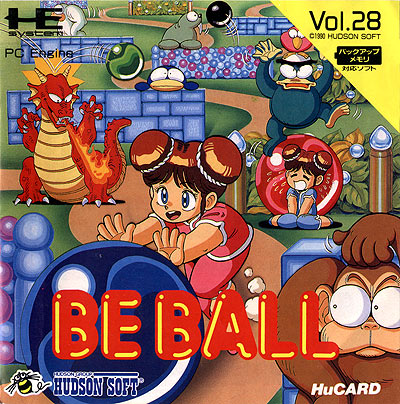
2. Chew Man Fu--It has to be said that this odd game's box art is far less interesting than its Japanese counterpart (called Be Ball). That said, it's appealingly colorful, and the illustration of the mustachioed dude serving as its focus isn't hideous. Because of that, I think it more than earns a spot on this list.


3. The Legendary Axe--Full disclosure: I've never been much of a fan of this gritty platformer, despite the fact that every other TurboGrafx-16 owner back in the day slobbered over it like it was a photo of Daniel Craig in the buff. I've always liked its cover art, though--thanks it large part to the humongous spider that takes up most of its acreage.

Friday, March 11, 2011

The Great Gaymathon Review #12: Monster Lair (PC Engine CD-ROM2)


Game: Wonder Boy III: Monster Lair
Genre: Platformer/Shooter
Developer: Alfa System
Publisher: Hudson
System: PC Engine CD-ROM2
Release date: 1989

I'm pretty sure I've told this story a number of times before, but I'm going to share it again just in case my memory is failing me (it certainly wouldn't be the first time): Monster Lair was the game that prompted me to buy the TurboGrafx-16 CD attachment way back when. I'd never played--or even heard of--the arcade original, so that wasn't what attracted me to this platformer-shooter hybrid. No, what attracted me to it was its bright, beautifully drawn graphics--especially its so-cute-they-could-make-you-puke enemies and bosses. There's more to Monster Lair than fetching foes, though; there's also a rockin' Red Book soundtrack and a whole lotta challenging levels (14, to be exact). All that said, I wouldn't buy this game expecting it to become your favorite PC Engine title, but I would expect it to be well worth whatever you pay for it (which, at this point, should be less than $20).


See also: Previous 'Great Gaymathon' posts

Friday, January 28, 2011

Mystery note

You know how I mentioned (here) that the online import game shop wolfgames.com is having a going-out-of-business sale? Well, shortly after I published that post I ordered a few heavily discounted games from said store.

Among the games I ordered: The PC Engine CD version of Wonder Boy III: Monster Lair (aka Monster Lair in the States).

While flipping through the game's manual a few minutes ago (my order arrived earlier today), a small piece of paper slipped out of it and fell onto the floor.

This is what I found when I unfolded it:


I can't read a word of Japanese, so I have no idea what the note says. That hasn't stopped me from obsessing about it, of course.

Was the author of this note a previous owner of the game? Did he or she like it, or hate it? Is he or she warning me that this copy of Wonder Boy III is cursed?

Those are the kinds of questions that are going through my head at the moment.

(Note: This post originally appeared on my other blog, iwasateenage pcenginefan.wordpress.com)

Wednesday, October 20, 2010

Is this an awesome cover or what?

While writing up today's "10 video games that made my life gayer" post, I came across the following box art, which graced the cover of the Japanese Mega Drive version of Wonder Boy III: Monster Lair.


I'm sure some of you will say it's scary, but I think it's awesome. Of course, I've always had a soft spot for the PC Engine/TurboGrafx-16 version of the game, so I'm hardly unbiased on this subject.