Showing posts with label JRPGs. Show all posts

Tuesday, March 29, 2022

On why The Cruel King and the Great Hero is a better bedtime story than it is a satisfying JRPG

When the folks at Nippon Ichi Software revealed The Cruel King and the Great King in early 2021, I was ecstatic. I adored The Liar Princess and the Blind Prince, a puzzler-platformer with a similar aesthetic and vibe--so much so I declared it one of my favorite games of 2019--and thus expected the world from this follow-up.

With The Cruel King and the Great King being a JRPG rather than a side-scroller, though, I couldn't help but wonder how artist and writer Sayaka Oda and her talented team at NIS would handle the genre switch.

I say this because The Liar Princess and the Blind Prince is a wonderfully accessible, streamlined, and unique take on the puzzler-platformer genre. Before I played it, it was hard to imagine how The Cruel King and the Great King would check those same boxes.


After finishing The Cruel King and the Great King, the difficulty makes perfect sense. Although the game is plenty accessible, and some may argue it's streamlined and unique, too, it's not streamlined or unique in the ways I hoped or expected it would be in the wake of The Liar Princess and the Blind Prince.

One noteworthy case in point: there's no traditional overworld map, dotted with towns and dungeons, to explore in The Cruel King and the Great King. Instead, the game presents players with a minimalistic map that's vaguely Metroidvania-esque. Rather than traverse it by jumping from platform to platform, though, you move from point to point by ambling left and right down tight and barren (but beautiful!) hallways.

This is a lot less taxing than scouring a vast overworld or stumbling through a maze-like dungeon, of course, but I personally never found it to be an enjoyable or satisfying alternative to the status quo, and I'm pretty sure most others would feel similarly about this odd design decision. (For the curious, Nintendo's Miitopia does a much better job of tweaking this staple RPG component.)


Another example of how The Cruel King and the Great King tweaks the RPG formula but ultimately fails to produce something gratifying: party members occasionally learn new battle skills, and some of them allow you to target groups of enemies that are lined up vertically, horizontally, or diagonally. Depending on the makeup of your party (and the alignment of your enemies), you can combine these skills to overwhelm the opposition.

Unfortunately, the game conspires in several ways to keep this from happening as often as it could or should. For starters, each character learns just one or two of these skills during an average playthrough. And not only that, but it can take a long time to learn them. Also, enemies typically are grouped in ways that make it possible to defeat some, but not all, using such combos.

Although that's hardly the worst thing in the world, I think The Cruel King and the Great King would have been a lot breezier and a lot more fun if it set things up to make these happen as often as possible. Especially since the game's tussles are fairly ho-hum otherwise.


The Cruel King and the Great King's battles disappoint--though underwhelm may be a better word here--in another important way, too. Early on, the game tells you that you can spare enemies in certain situations. To be honest, that notification basically went in one ear and out the other for me, or whatever the equivalent is for your eyes while reading. Later, I remembered it and looked it up online, worried I might be missing something vital or even playing the game "wrong."

I was missing something, it turns out, but not anything important--as far as I'm aware. If you manage to expose an enemy's weakness and make it sweat, you can let it escape. The thing is, exposing an enemy's weakness is easier said than done, especially early in the game, and even then, there's no guarantee the enemy will agree to flee.

As such, playing The Cruel King and the Great King like it's an Undertale knockoff isn't really possible. Which is just as well, as the game currently doesn't give you any reason to do so. Sparing an enemy doesn't benefit you in any way, or at least it didn't seem to during my playthrough. It was noted in my "monsterdex," but that's it.


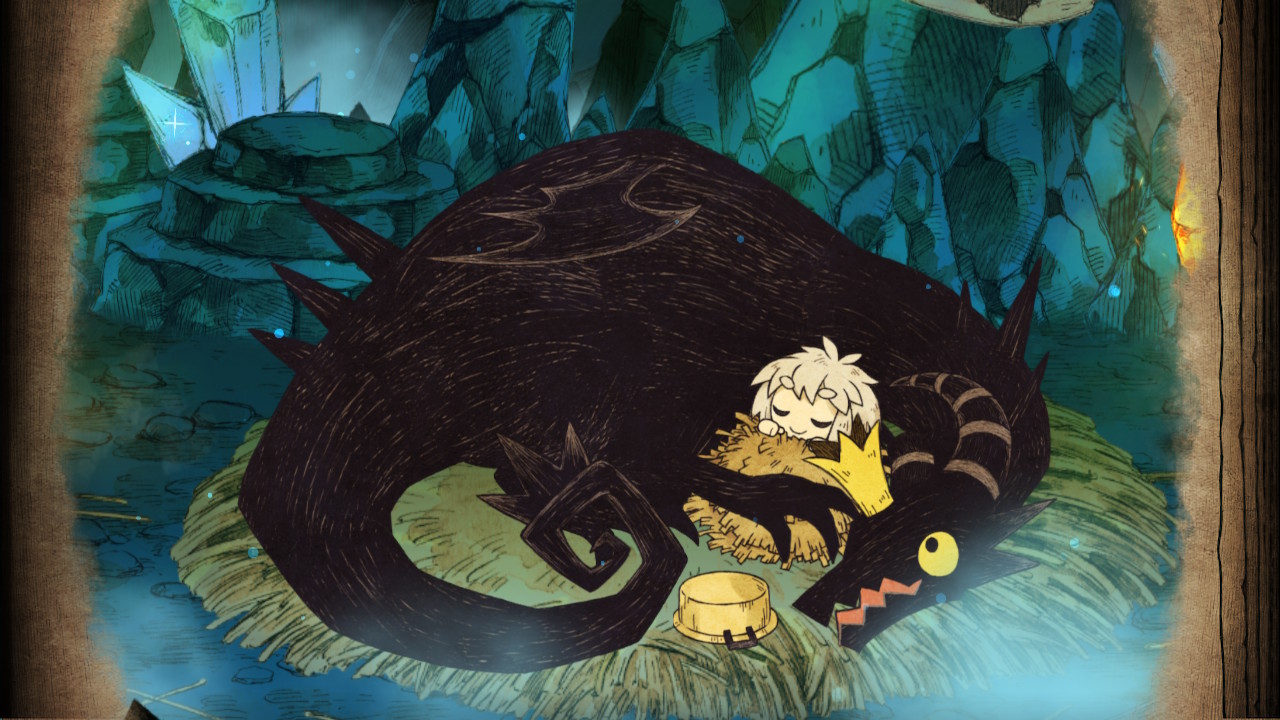
It's too bad The Cruel King and the Great King's designers and developers decided to incorporate this element into the experience and then do so little with it. Especially since the story, which follows an orphaned girl who is raised by a dragon and helps local monster-folk while training to become a "hero," is a perfect fit for such anti-RPG gameplay.

Based on what I've said so far, you're probably thinking I wish I'd never wasted my time and money on The Cruel King and the Great King. I don't--and keep in mind this is coming from someone who dropped big bucks on the game's pricey "Treasure Trove" bundle. Oh, sure, the protagonist's slower-than-molasses walking speed occasionally (OK, regularly) got on my nerves. And there were times when the frequency of the battles bugged me, too.

Still, I enjoyed it overall. Its story is the definition of heartwarming and is, without a doubt, the highlight of The Cruel King and the Great King. Its soundtrack is top of the line, too. Even after hearing its main battle theme 100 times, you won't tire of it--or at least I never did. And of course it's filled with gorgeous, hard-drawn art, like most Nippon Ichi games are these days. (See Yomawari, Mad Rat Dead, and Labyrinth of Refrain for evidence.)

There's no denying I expected more of it, though. I consider The Liar Princess and the Blind Prince to be one of the best games Nippon Ichi's ever made. I've played through it four times and would struggle to find fault with it if pressed on the issue.

Because of that, I had high hopes The Cruel King and the Great King would follow in that game's footsteps a bit more than it did. Oh, well, at least it came through with a killer bedtime story.

See also: The good, bad, and ugly of Heroland (or, why I'm thinking of walking away from this oddball RPG after putting 20-plus hours into it)

Saturday, December 22, 2018

How Let's Go renewed my interest in Pokémon

When Pokémon: Let's Go was revealed earlier this year, I paid it no mind.

My lack of interest had nothing to do with me being too cool, hardcore, or even old, mind you. Instead, it had to do with my, erm, "complicated" relationship with this long-running series.

You see, although I've bought a lot of Pokémon games over the years, I've barely played--let alone completed--most of them.

A few cases in point: before Let's Go, the only Pokémon title I ever "beat" was Red. I got close with Black, but became distracted as I approached its finale. All the rest, though? Well, I put about seven hours into X, and maybe four into Diamond and Emerald. Meanwhile, my copies of SoulSilver, Black 2, and Moon all remain unopened and unexplored.


Now my initial shoulder-shrugging in regard to Let's Go makes a lot more sense, right?

The thing is, although I was frosty toward this Switch remake at first, I thawed on it shortly after copies finally hit stores. Why? Glowing word of mouth, to be frank. Plus, screens and video footage of the game made it look like a lot of fun.

So, after a bit of hemming and hawing, I handed 60 big ones to the evil superpower known as Amazon for a copy of Pokémon: Let's Go, Eevee! and then (impatiently) waited for it to arrive on my doorstep.


Based on all of the above, you might assume the first few minutes I spent with this title were the gaming equivalent of love at first sight. They weren't.

In fact, after putting about an hour into it, I was wondering what on earth I'd done in buying it. I found it boring and slow. Honestly, if I hadn't spent so much money on it, I would've popped its cartridge out of my Switch and never looked back. Because I did drop a wad of cash on it, though, I stuck with it. A few hours later, I was all but smitten.

I can't point out to you the exact moment when my opinion of Let's Go, Eevee! changed, sadly. All I know is that I began one play session with a yawn and ended it with a grin splashed across my face.


That grin stayed in place for most of the next 40 or so hours I spent with the game, too.

I "blame" its charming cast of characters--the eponymous monsters, especially--for most of the pain I endured as a result of that days-long smile-fest, by the way. What can I say? There's just something about how the original 151 Pokémon creatures are depicted here that makes me happy.

The same could be said about the new, Pokémon Go-ish capture mechanism. A lot of people despise it, I know. I adore it. In the past, I often found the "wear 'em down until they're just about to faint" aspect of this series' random encounters to be draining. That's no longer an issue here.


Also, combining that aspect with wild Pokémon that are visible on the overworld map makes progressing through the game a breeze.

Are those three components really enough to change someone's mind on this series? I can't speak for anyone else, but for me that's certainly been the case--much to my own surprise, I have to admit.

Will my renewed interest in all things Pokémon (or at least some things Pokémon) remain strong if the mainline game that follows in the footsteps of Let's Go in late 2019 drops either or both of these last two bullet points from the back of its brightly colored box? I honestly don't know.

I can assure you I'll approach it with an open mind, though. And who knows? Maybe I'll walk away from it 50 or so hours later (as I did after I finished Let's Go recently) feeling like I got my money's worth from the purchase--something I've rarely been able to say about Pokémon games.

Saturday, October 06, 2018

Manual Stimulation: Susano-o Densetsu (PC Engine)

If only I'd penned and published this post last summer as intended.

Back then, one of my favorite retro-game blogs, The Brothers Duomazov, was still alive and well.

OK, so maybe "well" isn't the right word to use here. After all, it hadn't been updated in more than three years at that point.


I could access and enjoy all of its reviews of old PC Engine and TurboGrafx-16 games whenever I wanted, though, and that was more than enough for me. (I swear I read some of them at least 10 times each. They were like comfort food for me.)

I bring up The Brothers Duomazov, by the way, because it was one of the only sites that offered up any real information on this obscure, Japan-only RPG from 1989.

Also, it pushed me to buy a copy of the game. Before I read the brothers' thoughts on Susano-o Densetsu, I skipped right over it each and every time I came across it on eBay or my go-to online stores.


What can I say? Its cover art screams "bad game" to me--despite the fact that a buff dude is front and center and the esteemed Hudson Soft logo sits just below his hairless torso.

Well, The Brothers Duomazov opened my eyes to the fact that Susano-o Densetsu is far from a bad game. Actually, their write-up made it seem pretty darn interesting.

For starters, it's a HuCard-based role-playing game--an honest-to-goodness rarity as far as the PC Engine is concerned.


Also, its battles don't rip off Dragon Quest or Final Fantasy like pretty much every other RPG did in the late 1980s. Instead, fights in Susano-o Densetsu offer players a bit more freedom than was typical for the genre at the time.

Combine that with this Alfa System-made game's cyberpunk-ish aesthetic, and it should be easy enough to understand why I'm now a proud owner of a complete copy.

The instruction manual showcased in this post was pulled from the interior of that copy, naturally. It's quite something, wouldn't you agree? Admittedly, it could use a few (or a lot) more illustrations, but I think it's pretty fabulous even in its current state.


I especially like the full-page world map featured on its fifth page. And of course I adore the item and enemy drawings highlighted on the Susano-o Densetsu manual's final spread.

What's your opinion of this surprisingly beefy booklet? Do you love it? Do you hate it? Or maybe it doesn't inspire any kind of emotional reaction from you? Regardless, I'd love to hear your thoughts.

See also: previous 'Manual Stimulation' posts about Dungeon Explorer, KiKi KaiKai, Parodius Da!, and Son Son II.

Thursday, August 09, 2018

Ten things I'd change about Octopath Traveler if given the chance

My last two posts hopefully make it pretty clear I'm enjoying the hell out of Octopath Traveler at the moment.

As much as I love it, though, I don't think it's perfect. In fact, I'd make the following changes to the game if someone gave me the green light to do so.

1. I'd add a Bravely Default-like slider to the "settings" menu that lets you adjust the frequency of random battles. Being able to turn off random battles--or even increase how often they're triggered--was a real lifesaver, not to mention sanity-saver, while playing Bravely Default. Why Octopath Traveler's developers decided against including something similar here, I'll never understand.

2. I'd allow players to alter the game's difficulty on the fly, too. Again, like Bravely Default--or even the recently released Shin Megami Tensei: Strange Journey Redux. Both of those 3DS titles let you switch between easy, normal, and hard (or casual, standard, and expert, in the case of Strange Journey Redux) modes as you wish. Not only isn't that possible while playing Octopath Traveler, but it's not even possible to choose a difficulty level at the game's start. As such, if you run up against an area or boss that's too hard for you, you've got no choice but to grind your party into better shape or improve your battle strategy.

Illustration by carrotchipper
3. I'd make weapons visibly distinct during battle. I've loved being able to see my party member's weapons in battle since I first played through the original Final Fantasy shortly after it was released in my neck of the woods. In fact, I stuck with that game's "coral sword" long past its sell-by date because I thought it was cool to wield a pink blade. So imagine my disappointment when I realized I'd never get to see Octopath Traveler's "bear cleaver" or "war hammer."

4. I'd include a few more unique secondary jobs. In a way, I appreciate that the folks who called the shots during Octopath Traveler's development decided to cap the game's secondary jobs at 12. It's easy for RPGs to go overboard in this area and become bloated, confusing messes. Still, I wouldn't have minded even a couple of additional career options for my hard-working crew--especially since I consider a few of the included ones to be borderline pointless.

5. I'd shorten its battles. How much shorter would I make them? I'm not sure. Slightly shorter, at the very least. And I'd focus on Octopath Traveler's boss battles in particular. Yes, I feel accomplished and relieved and all sorts of other emotions after finally toppling one of this game's end-of-chapter baddies, but I'd sacrifice a bit of that elation for tussles that occasionally last less than 30 minutes.

6. I'd let people save anywhere. This is one of Octopath Traveler's more confounding omissions, if you ask me. I know the game's supposed to be a throwback, but this is going a bit too far considering nearly all modern RPGs allow players to save where they want and when they want. Plus, you encounter the little pedestals that serve as Octopath Traveler's "save spots" every few steps, so why not just remove that visual clutter from the landscape and replace it with something that's a lot more user-friendly?

7. I'd toss in a few vehicles. I know what some of you are thinking: vehicles aren't needed in this game because it lets you "fast travel." It only lets you do so between cities, though, which often means you still have to hoof it a bit if you want to explore a cave or hunt for a shrine. Even if Octopath Traveler allowed you to plop your party anywhere on the map with a nudge of the analog stick and the press of a button, I'd still want access to a handful of "vehicles"--like maybe a boat or carriage or horse--so I could buzz around the landscape when the mood strikes.

Illustration by punkratkid
8. I'd give players more money for winning battles. Or I'd make weapons and armor cheaper. As things stand, it's easy to feel "poor" while playing Octopath Traveler--especially as you toil through its first half or so. In fact, I mostly resorted to stealing armor and weapons and items from unsuspecting townsfolk during my first 30 or 40 hours with the game because of this. Maybe that's the point? Or maybe this is Octopath Traveler's way of telling me to spend more time grinding? Either way, I'd prefer it if the gear sold by this title's many shopkeepers were a little more "wallet friendly."

9. I'd make it so the lantern used in caves and grottoes is upgradable. Hell, I'd even force players to find or buy this accessory before they could comfortably probe Octopath Traveler's many dark and dank caverns. This starter lamp would be pretty dim, too, and the only way to make it brighter and more useful would be to replace it or upgrade it in some form or fashion.

10. I'd increase the game's wackiness quotient. Although Octopath Traveler occasionally shows it's got a nutty side (Olberic's ability to challenge nearly any NPC to a one-on-one duel is a prime example), it's usually a pretty staid experience. How would I make it a little zanier? By tossing in a couple of kooky, out-of-left-field bosses, for starters. I'd also add in some silly weapon classes--like the bells and harps that pop up in a number of Final Fantasy titles.

Would you alter Octopath Traveler in any particular ways if given the chance? If so, what changes would you make?

See also: 'ten things I adore about Octopath Traveler' and 'five more (kind of silly) things I adore about Octopath Traveler'

Sunday, August 05, 2018

BONUS ROUND: five more (kind of silly) things I adore about Octopath Traveler

If you follow me on Facebook or Twitter, you should be well aware of the fact that the bulk of my gaming time over the last month or so has been spent working my way through Octopath Traveler.

In fact, I've now devoted 55 or so hours to this much-ballyhooed Switch RPG, and I have a feeling I'll need to put at least 25 more into it before I wrap up all of its storylines.

It probably could go without saying that I'm thoroughly enjoying the experience, but I'm going to say it anyway. Actually, I already suggested it in my last post--about the "10 things I adore about Octopath Traveler."


So why am I belaboring the point today? To be honest, I thought I was done extolling Octopath Traveler's virtues when I published the write-up linked to above. A few additional virtues popped into my head this past week, though, and although my initial plan was to just stick them at the end of my earlier post, I figured they'd be overlooked.

Plus, I like that the components highlighted below are sort of silly.

The lantern you carry while in caves and grottoes--No joke, this was one of the details that most stood out for me when I watched Octopath Traveler’s first trailer more than a year and a half ago. It's the type of thing that would've thrilled me as a youngster (yes, I've always been a little weird), and it still brings a smile to my face today--even if it doesn't impact the gameplay as much as I'd like.


The mansions that double as dungeons--Is Octopath Traveler the first turn-based RPG to stick dungeons within manors and other such dwellings? Even if it isn’t, I love how it’s handled here. I especially enjoy ducking into rooms to see what may be hiding inside. I wish they featured a few secret nooks and crannies here and there (like the caves and grottoes do), but maybe producers Masashi Takahashi and Tomoya Asano are saving such treasures for the inevitable sequel?

The return of the “Final Fantasy V laugh”--Something I've always loved about the fifth Final Fantasy game is how adorable its characters look when they laugh. Well, Octopath Traveler’s protagonists and NPCs use a shockingly similar animation while guffawing or chortling. I don't know if this is an intentional reference to one of my all-time favorite games or if it's just a coincidence, but I'm going to assume it's the former until proven otherwise.


The shimmer--No, I'm not talking about the "Shimmer" that serves as a major plot point in the Annihilation film. I'm talking about the way some of Octopath Traveler's elements shimmer and sparkle in the most captivating way as you walk on or by them. You'll mostly observe this while traipsing around the game's sandy and snowy environments, or while exploring some of the aforementioned caverns, but you'll also notice it (in and on homes and shops) while strolling through its villages and towns.

The sound of your party’s footsteps--They sound like horses clopping, especially when your crew's walking across dirt or stone, and for whatever reason I find it comforting.

Now that I've had my say (again), what are your favorite aspects of Octopath Traveler?

Sunday, July 29, 2018

Ten things I adore about Octopath Traveler

I was pretty sure I'd like Octopath Traveler as soon as I finished watching the teaser footage of it that was featured in the "Nintendo Switch Presentation 2017."

That hunch persisted as I played its first demo, which hit the Switch eShop late last September.

How do I feel about Octopath Traveler now that I'm making my way through the full game? Well, I've put nearly 40 hours into it so far--what do you think?

If that's not enough detail for you, keep reading for a bit of commentary on the 10 things I most love about this throwback of an RPG.


The ability to steal--When I first added Therion ("the thief") to my party, I pretty much ignored his "steal" path action. I mostly used Tressa's similar ability, "purchase," instead. It quickly became clear to me, though, that buying armor, weapons, and items in this game is a fool's errand. Random battles just don't give you the kind of money you need to outfit your crew properly. So, I started stealing from non-player characters (NPCs)--and now I can't stop. Hopefully the game doesn't penalize me for it down the road.

The battle system--You know what excited me most during my four-hour playthrough of the first Octopath Traveler demo? The battles. They gave me powerful Bravely Default vibes--a very good thing as far as I'm concerned. Actually, I think the fights in Octopath Traveler are better than those in Bravely Default. They're certainly more visceral--especially when you "break" an enemy and your system's Joy-Cons offer up an impressive series of rumbles and jolts.


The effects and "filters"--I know a lot of people think the lovely spritework in this game is ruined by the effects its artists and developers applied to those assets, but I'm not one of them. Admittedly, there are times when the vignette and depth-of-field filters make it hard to see paths and easy to miss treasure chests, but I'd rather deal with that than have a game that's flatter and far less aesthetically pleasing.

The freedom--One of the most SaGa-esque aspects of Octopath Traveler is it allows you to go anywhere and at any time. Or, to put it another way, the game lets you do what you want, when you want to do it. This is far from the first RPG to offer such freedom, of course, but it still feels fresh here because of the eight characters--and on-going storylines--at your disposal. Get in over your head while trying to complete a particular chapter and you can simply switch to another. Or you can tackle an optional dungeon. Or you can search for one of the shrines mentioned below. Basically, what you do and when you do it is up to you.


The locales--If I had to hold up one visual element of Octopath Traveler as being more impressive than the rest, I'd go with its towns. Every one does its best to take your breath away the second you stroll past its entrance. This is mainly due to the unique and ornate architecture that fills each burg, but there are other reasons, too--such as the rivers that wind through a number of them and the bridges that cross those burbling waterways. When combined with the environmental details and backdrops, this game's hamlets basically beg you to explore them--and so far I've happily obliged.

The NPCs--In some ways, I like Octopath Traveler's NPCs more than I like its protagonists. There are so many of them, and almost every one has a story to tell. You're able to hear these tales not only by chatting up townsfolk as you would in any other RPG, by the way, but also by using Alfyn's "inquire" and Cyrus' "scrutinize" abilities. Accepting and completing side quests from and for some of these NPCs sheds even more light on their intriguing backgrounds.


The party members--I know Octopath Traveler's eight protagonists are kind of clichéd and trope-y, but I don't care. I like them anyway. I especially like the plucky merchant, Tressa, and the out-for-vengence dancer, Primrose. OK, so I have a soft spot for the cluelessly dreamy (not to mention Sherlock Holmes-y) scholar, Cyrus, and the wet-behind-the-ears apothecary, Alfyn, too. Oh, who am I kidding? I'm pretty fond of all the game's party members, though I'll admit the hermit warrior, Olberic, and the stoic hunter, H’aanit, are my least favorites.

The sense of mystery--Something I've often wished RPGs would feature more of are secret locations. Well, Octopath Traveler has loads of them. Hidden within the landscape that stretches between the game's towns and forests and caverns are caves and tombs that double as optional dungeons and shrines. (You learn secondary "jobs" in the latter.) Believe me when I say stumbling upon one of them is among the most thrilling and satisfying aspects of this globe-trotting adventure.


The soundtrack--It's been apparent since Octopath Traveler's initial tease that its soundtrack was going to be a stunner. Even so, I was unprepared for the brilliance that wafted into my ears the minute I hit "start." The tunes I've heard so far are elegant and emotional and wistful in ways that remind me of the ones I fell in love with while playing Final Fantasy V and VI for the first time back in the day. Need I say more?

The "travel banter"--As you may have heard, Octopath Traveler's eight protagonists never really acknowledge each other during the normal course of play. Those walls come crashing down after certain events, though, and when they do, pressing the plus button on your Switch lets you listen to the banter between two or more party members. These chats aren't exactly deep--they're usually just a few lines long--but they still provide a welcome look at the behind-the-scenes relationships of this tit;e's colorful cast of characters.

Are you playing Octopath Traveler, too? If so, what are your favorite aspects of it?

See also: 'five more (kind of silly) things I adore about Octopath Traveler'

Saturday, February 24, 2018

What kind of idiot buys Final Fantasy IV: The After Years WiiWare episodes in 2018? This kind!

I nearly did something really dumb earlier this week. Yes, even dumber than buying Final Fantasy: The After Years WiiWare episodes in 2018.

The dumb thing in question: I got this close to ordering a Japanese Wii just so I could buy a bunch of that region's Virtual Console releases before Nintendo stops letting people buy Wii Points on March 26.

Actually, the first part of that plan wouldn't have been the dumbest decision in the world. Used Japanese Wiis aren't too expensive at the moment, after all. What would have been pretty dumb, though: dropping a load of cash on a ton of games I already own in physical form.

In the end, I decided picking up a used Japanese Wii wouldn't be the best use of my hard-earned cash.

I still had the Wii eShop on the brain, though, and that prompted me to start thinking about the North American Virtual Console and WiiWare titles I could purchase with some of the money I previously planned to plop down on the aforementioned imports.

My first thought was to grab some of the old games I've stupidly overlooked since they first hit the Wii eShop--like Phantasy Star for the Sega Master System, Monster Lair for the TurboGrafx-16, and Kirby 64 for the Nintendo 64.

I actually bought two of those games--Monster Lair and Kirby 64--yesterday. Along with those titles, I bought all of the Final Fantasy IV: The After Years WiiWare episodes I'd previously passed on.

Thankfully, I only had to buy three of them--for a total of 1,400 Wii Points ($14). I went in thinking I'd have to pay for all but the initial three episodes and maybe Rydia's, so discovering I'd nabbed three others at some point was quite a thrill.

Why did I waste $14 on all this, especially considering I own Final Fantasy IV: The Complete Collection for the PSP, which includes the entirety of The After Years?

The only explanation I can offer up is it didn't feel right to me that my "copy" of the WiiWare version of The After Years would forever be incomplete if I failed to pay for the rest of its optional content.

Also, I'm more likely to boot up my Wii than my PSP at this point in time, strangely enough. And then there's the fact that I've already completed the game's first three chapters (the prologue as well as Ceodore's and Kain's "tales")--not that I can remember anything about them now.

The question is: will I ever work my way through all of these colorfully titled episodes ("The Eidolons Shackled" and "The Vanished Lunar Whale" among them) I just picked up, or will they forever remain unplayed?

Your guess is as good as mine. I'm certainly going to give it my best shot, though. Final Fantasy IV is one of my all-time favorite games, so I'd really like to experience this direct follow-up--and sooner rather than later.

Have any of you played the WiiWare version of Final Fantasy IV: The After Years, or even one of the versions released for the PSP, PC, or mobile? If so, what did you think of it? And based on that experience, do you think I've made a wise move or gone off the deep end?

Sunday, December 24, 2017

A few thoughts on the Project Octopath Traveler Switch demo now that I've finally played through it

There's something hilarious--to me, at least--about the fact that I went against my original plan of waiting until 2018 to buy a Switch and instead picked up one in late September mainly so I could check out the just-released Project Octopath Traveler demo.

What's so funny about that, you ask? Well, although the first thing I did after turning on and updating my Switch was download the aforementioned demo, all it's done since then is sit on my home screen and look pretty.

I finally booted it up a couple of days ago, and now I can't put it down. Honestly, I'm completely mesmerized by this bite-sized preview of Square Enix's upcoming "HD-2D" role-playing game for Switch at the moment. Here's why:


I really appreciate how its story at least attempts to be more "adult"--Most of the RPGs Square Enix has made for Nintendo systems (handhelds, in particular) in recent years have featured stories that are more childish than mature. Based on this demo, it seems Project Octopath Traveler may buck that trend. To be sure, I don't know that I'd even describe the text encountered here as being R-rated, but it's certainly closer to that than the PG-leaning narratives usually found in the company's Nintendo releases, and for that I'm grateful.


Its visuals are the perfect blend of old and new--On the one hand, Project Octopath Traveler doesn't look too different from the kinds of games Square put out during the 16-bit era (see: Final Fantasy VI, Romancing SaGa 3, and Seiken Densetsu 3). On the other, it also looks surprisingly modern, thanks to its three-dimensional--yet still pixelated--backdrops and heavy use of bloom and other special effects. Put those two together and you've got a game that makes me want to cry due to its gorgeousness. Yes, the vignetting can be a bit much at times, but even then I love Octopath's aesthetic and hope producer Tomoya Asano and his team don't touch it between now and whenever the full game is released.


Yasunori Nishiki's soundtrack is a revelation--OK, so obviously I'm only talking about the music that's featured in the demo or that's been teased on line. Still, that small handful of tunes is more than enough for me to feel confident the full Project Octopath Traveler soundtrack will be a stunner. Which is a bit of a surprise, as composer Yasunori Nishiki is far from a household name at this point. I'm not at all sure he's going to give Project Octopath Traveler players something that approaches the ear-popping brilliance of Bravely Default's "Baby Bird" with the work he does here, but maybe that's for the best.


No joke, I think I prefer Project Octopath Traveler's battle system to Bravely Default's--And this is coming from someone who loved Bravely Default's battle system to death. Why? Project Octopath Traveler's is a lot snappier, for starters. Also, it's also more visceral, if that makes any sense. I feel a real jolt whenever one of my party members unleashes four strikes in a row against a foe while playing this demo. The battles in Project Octopath Traveler seem to be more dynamic than those in Bravely Default, too, due to subtle camera movements and some of the aforementioned graphical effects. Again, fingers and toes crossed that Asano and his crew don't mess with this aspect of the game before the final product sees the light of day.


I'm kind of surprised enemies remain static while fighting, but I also can't say it bothers me--I've seen a number of people complain about this on line, and although I can't fault their critiques, I also can't agree with it. Or at least I can't say the lack of enemy animations is keeping me from enjoying Project Octopath Traveler's battle scenes. Who knows, though, maybe the full game will surprise in this regard by adding a hint of movement to boss encounters or something like that.

So, that's how I feel about the Project Octopath Traveler demo after putting more than three hours into it. If you've played through it, too, share your thoughts, opinions, and impressions in the comments section of this post.

Saturday, December 09, 2017

To buy the Romancing SaGa 2 remake for Switch or Vita, that is the question

I've been awaiting an English release of Square Enix's Romancing SaGa 2 remake--or remaster, if you prefer--for a surprisingly long time.

Hell, I've been waiting for the game to be made playable in English, period, since it first hit the Super Famicom back in late 1993.

After all, the Romancing SaGa titles are about the worst games you could attempt to play through if you don't have a mighty firm grasp of the Japanese language thanks to their open-ended nature and ridiculous amount of (kanji-heavy) text.


Sadly, none of the fan translations of these games have ever progressed to a point where they could be said to be playable. As such, I bought the iOS version of the above-mentioned Romancing SaGa 2 remake the day it made its way on to the North American App Store early last year--despite its rather hefty price tag of $17.99.

Unsurprisingly, I've barely touched it in the year-plus since. Oh, I started it, and I didn't find its touchscreen controls to be anywhere near as off-putting as I assumed they'd be, but, as is the case with pretty much every mobile game I've bought to date, I just couldn't stick with it.

So, I've not-so-secretly held out hope that Square Enix would eventually bring the Vita version of the Romancing SaGa 2 remake--released in Japan alongside the mobile iteration in March 2016--to our shores.

Just when I'd about given up on that ever happening, series creator Akitoshi Kawazu took to Twitter to mention he and his team were still working toward that goal (while also prepping a similarly updated version of Romancing SaGa 3).


That was all the way back in April, though, and Kawazu's barely made a peep about the fate of the English release of Romancing SaGa 2's Vita port since, so let's just say yesterday's announcement that it'll be available for purchase on the North American PlayStation Store on Dec. 15 proved to be a bit of a curveball.

Even more of a curveball was the news that PC, PS4, Switch, and Xbox One owners also will be able to buy and play the Romancing SaGa 2 remaster on that same date. (Visit japanesenintendo.com to see the game's latest trailer.)

Which of course begs the question: which version should I pick up?

My initial response was to go with the Vita iteration, as that's the one I've always wanted. It wasn't long before I changed my mind and decided I'd rather experience the game on my new go-to system, the Switch.


As of this morning, though, I'm no longer so sure. Yes, the Switch has a bigger screen and I use it far more than I use my Vita at the moment, but the Vita has a better, longer-lasting battery and it also simply seems like the right "home" for such a game.

What do all of you think I should do here?

Also, are any of you planning to purchase some version of the Romancing SaGa 2 remake when it drops in a few days? If so, which one?

Monday, October 02, 2017

Why, yes, I am still plugging away at Opoona (Wii)

Or at least I was plugging away at it before I became obsessed with the classic Famicom RPG, Mother, and before I got my hands on a Nintendo Switch. (You can read about my experience with the game otherwise known as EarthBound Beginnings in this post, by the way. And you can reach about my recent Switch acquisition here.)

Regardless, during my last Opoona check-in, I crossed the 20-hour threshold.

That may surprise some of you, as I've made no secret of the fact that this ArtePiazza-made RPG has frustrated and annoyed me on a number of occasions since I first booted it up a couple of months ago. In fact, I detailed most of them in a recent blog post, "A few thoughts on Opoona (Wii) now that I've finally played it for a couple of hours."


Despite its shortcomings, I've enjoyed my time with the game overall. Its combination of intriguing battles, a delightful art style and a brilliant soundtrack tend to outweigh its confusing environments and awkward camera angles.

I say "tend to" here because right around the time I hit the 10-hour mark in Opoona, its negative attributes abruptly overtook its positive ones. That's when it dawned on me that I likely got myself stuck due to a bit of miscommunication (which isn't an entirely unusual occurrence while playing this overlooked Wii game, I'm afraid--thanks in large part to its often-iffy localization).


I won't bore you with all of the details, as they'll be little more than gobbledygook to folks who've yet to experience Opoona, but here's the gist: at one point in the game, you're sent to a place called "Blue Desert" to complete a job. (These are kind of like, but not exactly like, fetch quests in other RPGs--although here they sometimes require you to complete mini-games.) Unbeknownst to me, one of that location's many residents helps you unlock additional jobs, although you have to chat him up and do something for him before he'll assist you in that way.

Although I remember talking with him, I don't remember him telling me he'd grant me access to another job. Or maybe he told me, but shortly thereafter I walked away from the game for the night and promptly forgot the conversation. Regardless, I left Blue Desert before taking him up on his offer--which would have been all well and good if weren't for the fact that you're not allowed to return to the area at that point in the story.


As for why leaving Blue Desert before lending the aforementioned guy a hand caused me to get (temporarily) stuck, that would be because you need the job he opens up to advance to one or more other areas of the game's world.

Thankfully, after a lot of stumbling around, just as much awkward Internet sleuthing and somewhere between five and 10 additional hours of gameplay, I got myself unstuck and pushed forward with my sometimes-aggravating Opoona adventure.


In fact, I've since pushed it forward to the point I'm pretty sure I'm nearing its end. For those of you who've played (and finished) Opoona: is that possible?

I honestly hope it is, because although I've enjoyed a fair bit of my Opoona playthrough, I'm not sure I could handle, say, another 10 or 20 hours of annoying camera angles and needlessly confusing text.

Who knows, though; I've certainly put myself through worse over the years. In other words, don't be surprised if I drop yet another blog post in the near or even distant future in which I celebrate the fact that I conquered Opoona and all of its unfortunately irritating components.

Saturday, September 30, 2017

A few thoughts on the Monster Hunter Stories 3DS demo after putting about five hours into it

Just over a month ago, Nintendo plopped a demo for Monster Hunter Stories onto the North American 3DS eShop.

I promptly downloaded it, of course. And I say "of course" here because I've been curious about this Pokémon-esque Monster Hunter spinoff since it was released in Japan last fall.

That's not to say I promptly played through its demo. Although I put maybe 30 minutes or an hour into it shortly after my download finished, I didn't really dig into it until a week or two later (mainly because I was obsessed with Mother at the time).


As of now, I've played it for nearly five hours. Based on what I've read on line, there's still a few hours of content left for me to explore. Rather than wait until I hit that wall to write up my thoughts on this Monster Hunter Stories teaser--which is what I'd normally do--I decided to jot down and share them now.

Why the rush? Well, for starters, I'm really enjoying the demo--even more than I expected to, if I'm to be honest. Plus, I'm pretty sure nothing's going to pop up in the next hour or two that will change my opinion of Monster Hunter Stories.

With that out of the way, here are some of my thoughts on this surprisingly generous demo:

It looks absolutely lovely--I've liked Monster Hunter Stories' art style since I first laid eyes on it way back when. OK, so I wasn't initially all that keen on the design of Navirou, your odd-looking Felyne sidekick, but I eventually came around to it. I've always found the game's human designs appealing, though. They're cute without being generic or anime-esque, if that makes sense. I also really dig how the designers at developer Marvelous used a lot of bold, saturated colors while crafting Monster Hunter Stories' vast environments.


Its battles are more enjoyable than I thought they'd be--No one is going to accuse Monster Hunter Stories' fights of being confusing or complicated. In fact, they're little more than rock-paper-scissors bouts. That's fine with me, though, as it keeps them moving along at a good clip--which can't be said of all modern RPGs, that's for sure. My only worry is they might become boring while playing the full game. Considering that's rarely been an issue for me before, though, I don't see it impacting my decision to pick up a physical copy or not.

It chugs a bit on an original 3DS system--I don't know how the Monster Hunter Stories demo runs on other 3DS hardware, but it slows down and stutters now and then on an original unit. It doesn't do so all the time, and it's hardly that annoying, but I thought I should bring it up anyway. The question is: does the full game chug a bit on early 3DS systems, too, or does it perform better than this demo? Thankfully, I can play the former on my New 3DS if need be, but I'd prefer to play it on my "flame red" unit.


It's convinced me to buy the full game--Don't take this to mean me picking up a boxed copy of Monster Hunter Stories is a sure thing. I'd certainly like to do that, and soon, but the fact is my recent Switch acquisition is going to force me to be pretty picky with my game purchases for the foreseeable future. I still want quite a few 3DS titles--many of which I wrote about in this post from April, although I highlighted two others here and here--after all, and then there are Switch and retro games to consider, too.

Oh, well, even if I don't buy the retail version of this Pokémon wannabe, it won't be because I disliked its demo. How about you? Have you played either the Monster Hunter Stories demo or full game? If so, I'd love to hear your thoughts on it in the comments section that follows.

See also: 'I tried the Hey! Pikmin demo and I think I liked it'

Thursday, September 28, 2017

Anyone else planning to pick up The Alliance Alive when it hits North America in early 2018?

Actually, I'm not "planning" to pick up The Alliance Alive when it's released here this coming March, as I've already pre-ordered a copy via Amazon.

In case this is the first you're hearing of--or reading about--The Alliance Alive, it's basically a semi-sequel to another FuRyu-made 3DS RPG I found so appealing I bought it twice. (See my post on my Japanese copy of The Legend of Legacy, as well as my post on my North American copy of the game, for visual proof.)

Although different groups of developers and designers made The Legend of Legacy and The Alliance Alive, they're surprisingly similar, SaGa-esque games. Both are RPGs that allow players to select from a bevy of unique protagonists and then set them loose on a decidedly open-ended adventure.


One notable difference between the two games: The Alliance Alive provides a pretty traditional overworld for players to explore, while The Legend of Legacy offers up a single hub town and a series of maps that can be gradually unlocked.

To be honest, I'm not all that interested in owning the art book, CD soundtrack or keychain that will come packed inside the launch edition's sure-to-be-bulky collector's box (see above), but it seems there'll be no other way to buy a physical version of game early on, so I guess I'll have to stash away everything but the cartridge once it all arrives on my doorstep.

Anyway, that's where I stand on The Alliance Alive at the moment. How about you? Have any of you pre-ordered it, or are you planning to purchase it either before or after it's released in the West?

Thursday, September 14, 2017

Square Enix's Project Octopath Traveler looks like a love child of Bravely Default and Romancing SaGa, and that thrills me

Although it had its flaws and was far from perfect, I really enjoyed playing through Bravely Default a few years back.

Combine that with my nearly life-long interest in Square Enix's old (and on-going) SaGa series and, well, it should be easy enough to understand why I'm thoroughly intrigued by the company's upcoming Switch RPG, Project Octopath Traveler.

After all, Project Octopath Traveler looks like a thrilling mashup of the above-mentioned titles in its latest trailer (below), wouldn't you agree?


Sadly, I can't say for myself whether or not this 2018 release lives up to that pedigree, as I don't yet own a Switch and so can't play the Project Octopath Traveler demo that was made available via that system's eShop following yesterday's Nintendo Direct broadcasts.

I can guarantee you, though, that I'll play that demo for all it's worth once I finally get my hands on a Switch--assuming that happens before the retail version of Project Octopath Traveler hits the streets, of course.

In the meantime, what do all of you think of this "HD 2D" RPG? Does it thrill you, too, or does it make you shrug your shoulders in disinterest?

Tuesday, August 29, 2017

Don't mind me, I'm just completely obsessed with Nintendo's Mother at the moment

My apologies for failing to publish anything new here over the last week. Between Hurricane Harvey (which dumped a ton of rain on Austin but otherwise spared the city the kind of devastation seen in Houston) and a bit of "back to work blues" (now that we're settled in our new home, my husband and I have decided to end our sabbatical year a few months short and start looking for jobs), I haven't been in the mood to write.

I have been in the mood to play games, though. Or at least I've been in the mood to play Mother--aka, the RPG known to a lot of Western Wii U owners as EarthBound Beginnings.

Unfortunately for the other titles I was enjoying before I started Mother--Dragon Quest for Famicom, Great Greed for GameBoy, the Monster Hunter Stories 3DS demo and Opoona for Wii among them--that's all I've been in the mood to play for the last 10 days or so.

In that time, I've spent nearly 20 hours with Shigesato Itoi's first foray into the world of video games.


I actually put a few hours into Mother (or rather the leaked EarthBound Zero ROM) a few years back, but left it behind for some reason I can't remember and never returned to it.

There's no way something similar happens this time around, I can assure you. Although I enjoyed my initial attempt at the game, I'd hardly say the experience blew me away. That's exactly how I'd describe Mother's current effect on me, though.

Yes, it is antiquated in many of the same ways most Famicom and NES RPGs are--with the first Dragon Quest and Final Fantasy titles being prime examples. Yes, it basically requires you to grind. Yes, it's often frustratingly and even hilariously brutal.

But it also can be surprisingly touching. And weird. And beautiful.

That last comment is sure to raise a few eyebrows, but I refuse to take it back. Which isn't to suggest I considered Mother to be a work of art from the word go. My first impression of it was that it looked like a rough--very rough--draft of its 16-bit sequel. Over time, though, my opinion of its aesthetic softened quite a bit.

The first visual component of Mother that got me to think of the game as something other than messy was its enemy sprites. Almost without exception, they display a decidedly American cartoonishness that is perfectly fitting for a title that's set in, and tends to poke fun at, the United States of the 1980s.


There are other touches that add to Mother's visual appeal, though, if you keep your eyes open for them. The Peanuts-esque character sprites are a noteworthy example, as are the rather scraggy environments. (To be fair, the latter can seem samey, but each one features at least a handful of grin-inducing details that make it easier to stomach the monotony encountered elsewhere.)

That said, I wouldn't recommend playing Mother (or EarthBound Beginnings) for its graphical flourishes. No, the game's refreshingly nontraditional setting and bizarro sci-fi story are the main bullet points that should prompt you to boot it up in whatever fashion makes you the most comfortable.

All of the above-mentioned reasons--as well as the magnificent soundtrack composed by Keiichi Suzuki and Hirokazu Tanaka--are without a doubt responsible for fueling my obsession with this decades-old (it first hit Japanese store shelves all the back in 1989) role-playing game. Here's hoping they continue to fuel it right on through Mother's credit roll.

See also: 'a few thoughts on Opoona (Wii) now that I've finally played it for a couple of hours'

Saturday, August 05, 2017

A few thoughts on Opoona (Wii) now that I've finally played it for a couple of hours

Although I've owned a copy of this unique RPG for years now, its disc hadn't seen the innards of my Wii until a week ago.

What prompted me to get off my lazy butt and (finally) start playing Opoona? One of the first things I did after getting settled into our new home was hook up my Wii (mainly to see if it still worked), which in turn pushed me to unpack and organize all of my games.

Looking through my collection of Wii titles made me realize just how many of them I'd never even booted up. So, I decided then and there to free a few from their plastic prisons--beginning with this ArtePiazza-made oddity and Namco's similarly weird Tabemon. (Don't worry, I'll share impressions of the latter in an upcoming post.)


Since then, I've put approximately six hours into the former. That's an accomplishment worth crowing about, if you ask me. After all, Opoona's first hour or two are the definition of challenging. Not because its random battles are overly tough, mind you; rather, it's because the game takes its sweet time in telling you the protagonist's backstory and introducing you to the game's world. Also, the first area ("dome," actually) it drops you into is a real bitch to navigate.

Thankfully, things pick up a great deal once you're allowed to do as you please--which in Opoona generally means trying out a number of curious "jobs" and tackling the various quests that are associated with them.

The first job you're given is called "ranger." Sounds intriguing, I know, but in reality the ranger job is similar to the generic "fighter" role offered up by any other JRPG that's ever seen the light of day.

So, early on in Opoona, you accept a few tasks that force you into the forest that surrounds the opening dome (more become available in time) to fight alien-looking baddies using the titular character's "bon-bon."


Speaking of Opoona's bon-bon, it's the game's main claim to fame--and for good reason. For the unaware: the bon-bon is your main weapon while playing Opoona. It's controlled using the analog stick on the Wii nunchuck peripheral. While in battle, you pull back on the stick (or push it forward, or to the side) and then let it flick in the opposite direction to send your bon-bon careening toward one or more of the enemies that stand before you, à la Dragon Quest.

That's related to another of Opoona's selling points, by the way. If you want, you can play it one-handed, using only the Wii nunchuck. Personally, I prefer using the Wii remote as well, but I like that the game's developers included such an accessible control option.

Anyway, back to Opoona's job and quest system. I only have experience with the ranger and attendant jobs so far, but that's enough for me to guess the game is going to take me in some strange directions between now and whenever I'm finished with it.

Why? Take the attendant job. The first few quests or tasks you're given upon accepting that occupation have you filling orders at an intergalactic fast-food joint and delivering room service at a bustling hotel.


Admittedly, tackling those tasks is a lot less enjoyable than taking out baddies with the rubber-ball-esque bon-bon, but it's a nice change of pace nonetheless.

Given the above, it should be pretty clear that Opoona isn't your typical console RPG. For the most part, I've found that to be a good thing during my six-hour playthrough. I like its characters, I like its sci-fi setting, I like its snappy battles, I like its breezy soundtrack, and I like its overall aesthetic.

On the other hand, traversing the game's (unquestionably beautiful) environments veers between semi-tedious and tortuous. The huge domes that serve as its hubs are especially enraging. The game fails to provide you with a useful map, so when an NPC says something like, "go ask Mary in the library about this," you invariably spend a good 10 or 15 minutes (if not more) trying to find said location.

The fields outside Opoona's domes are less aggravating in terms of their layouts, but that doesn't mean they're without fault. My main knock against them at the moment: although you can move the camera while wandering around the game's interior spaces, you lose that freedom while outdoors. As a result, it's not unusual to find yourself in awkward positions that make it difficult to parse exactly where you are or where you're going.


Those gripes currently keep from flat-out recommending Opoona, but they aren't keeping me from continuing through its adventure. The bulk of it interests me to the point that the aforementioned niggles are fairly, but not entirely, easy to ignore.

Who knows if that will hold true until I encounter its credit roll, or until I prematurely walk away from the game--whichever happens first. I hope it will, though, as I'd really like to see Opoona through to the end.

In the meantime, have any of you played this Koei-published Wii title? If so, what's your opinion of it?